
Ziver bey Ahmadbeyov
Not every architect is fortunate enough to have a statue erected in front of a building they designed. But what kind of life stood behind this fame and creative legacy?
When we look at the life of Ziver bey Ahmadbeyov, the first architect from Azerbaijan to receive a formal architectural degree, we see not only an architect who left his mark on the city, but also a man whose life ended in tragedy.
Education
Ziver bey Ahmadbeyov was born in 1873 in the city of Shamakhi. After completing his secondary education there, he came to Baku to continue his studies and attended a gymnasium.
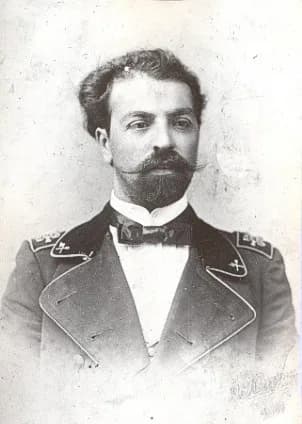
Known as one of the talented and hardworking students at the gymnasium, Ziver bey entered the Institute of Civil Engineers in St. Petersburg in 1893. His education was financially supported by the millionaire Shamsi Asadullayev. At that time, the institute was one of the most prestigious educational institutions in the Russian Empire, and most of its students came from wealthy families.
Ziver bey also distinguished himself there as an active and talented student and was elected a member of the Russian Society of Architects and Fine Arts, which operated in St. Petersburg.
While still a student, he met Hasan bey Zardabi and Ismail bey Gasprinsky in St. Petersburg. The meeting left a deep impression on him. Hasan bey described him as an intelligent and open-minded young man, valued his abilities highly, and advised him to continue his professional work in Baku.
The impression this meeting made on Ziver bey can be felt in a letter he later wrote to Hasan bey: “Our meeting is still in my memory. I will never forget what you gave me. I believe that we will meet again very soon.”
Career
Mosque projects also held a special place in Ziver Bey’s work. One of these projects was carried out at the initiative of Ajdar Bey Ashurbeyov. Known for his charitable activities, Ajdar Bey decided to build a mosque in the city and first began searching for a suitable site. Eventually, an area known at the time as Ganli Tepe was selected.
In 1918, the same year the Azerbaijan Democratic Republic was established, Ziver bey was appointed chief architect of Baku.
Ajdar bey Mosque
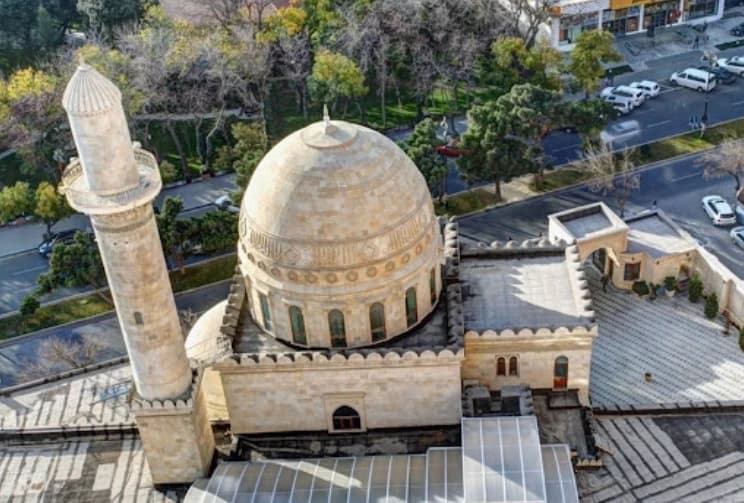
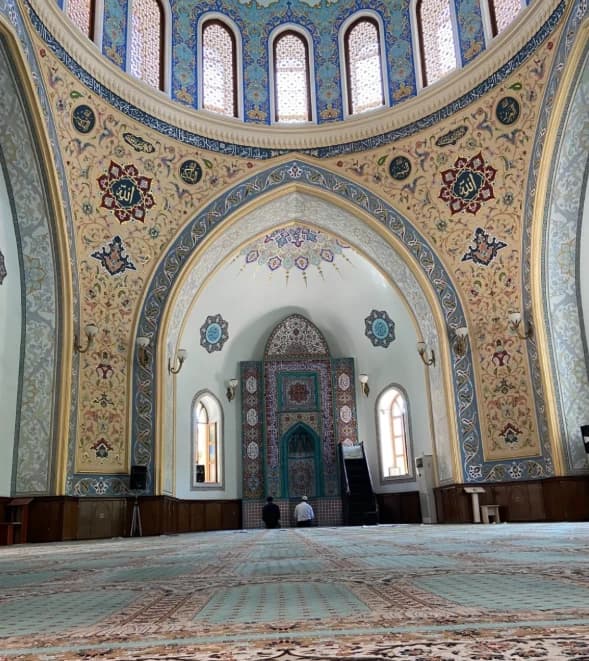
The initiative to build another mosque in Baku came from Ajdar bey Ashurbeyov. Known as a philanthropist, Ajdar bey first searched for a suitable site in the city. Eventually, an area known at the time as Ganly Tepe was selected.
The design of the mosque was entrusted to Ziver bey Ahmadbeyov. For this project, the architect drew inspiration from important examples of Eastern architecture. Using certain architectural elements from the Kaaba in Mecca and the mosques of Karbala, he created a distinctive composition of his own.
Ajdar bey approved the design, and construction began on what is now known as the Blue Mosque, or Ajdar bey Mosque. The mosque was completed and opened for use in 1912–1913.
Abulfazlil Abbas Mosque
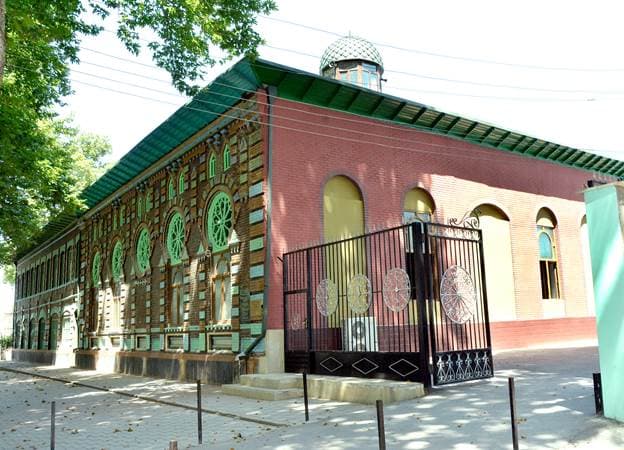
The Abulfazlil Abbas Mosque, built in the center of the city of Goychay in 1902, was also designed by Ziver bey Ahmadbeyov.
Previously, a small mud-brick mosque had stood on the site. However, in 1896, the building was demolished and a new mosque was constructed in its place.
Murtuza Mukhtarov Mosque or the Twin-Minaret Mosque
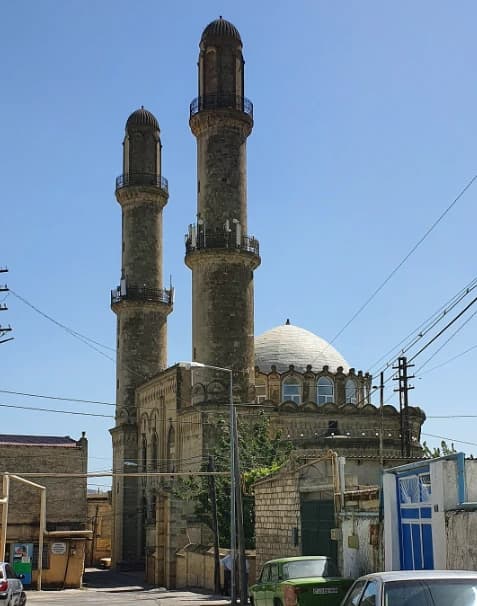
Construction of the mosque began in 1901 at the initiative of local residents. However, the work was left unfinished because of a lack of funds. The oil millionaire Murtuza Mukhtarov then took over the construction, and the building was completed in 1908 based on a design by Ziver bey Ahmadbeyov.
The mosque is distinguished by its two tall minarets. The twin minarets, each 47 meters high, are among the building’s main architectural features.
The mosque also held special significance for Murtuza Mukhtarov. He prayed there and donated to the mosque a Qur’an specially commissioned in Istanbul. This Qur’an, which is reportedly still preserved in the mosque, is said to weigh approximately 25 kilograms, with the words “Allah” written in gold leaf.
During the Soviet period, the mosque was closed. For a time, the building was used as a textile workshop, and between 1985 and 1988 it was converted into an exhibition hall for the works of Sattar Bahlulzade. Since 1989, it has once again been used as a place of worship.
“Saadat” School
The “Saadat” School for Boys, located at the foot of Chemberekend in Baku, was built in 1912–1913. The building stood out among the educational institutions of its time for its distinctive layout and expressive architectural design.
The architecture of the school incorporates Azerbaijani and Eastern motifs, while the main façade was designed in a more elaborate and formal manner. The harmonious combination of architectural details, proportions, and local stylistic elements made the “Saadat” School one of the notable public buildings of Baku of that period.
Death
After the collapse of the Azerbaijan Democratic Republic in 1920, the life of Ziver bey Ahmadbeyov, like that of many members of the national intelligentsia, became increasingly difficult.
Many of the intellectuals, friends and acquaintances around him were killed or imprisoned. Those who were more fortunate managed, with great difficulty, to leave the country and settle abroad.
Ziver bey witnessed what was happening and understood that it would soon be his turn to face arrest or persecution. Unable to withstand the pressure, he took his own life by shooting himself at his home in Chemberekend on the morning of February 16, 1925. He was only 52 years old.
At that time, a policy aimed at eliminating the national intelligentsia was being carried out in Azerbaijan. Ali Mardan bey Topchubashov, who was following the events from France with sorrow, conveyed the tragic news to Mammad Amin Rasulzade in March.
He wrote: “The news of Ziver bey Ahmadbeyov’s suicide saddened me deeply. Unfortunately, we do not know what caused Ziver bey Ahmadbeyov to meet such a tragic end.”
Mammad Amin Rasulzade, who investigated the reason behind Ziver bey’s suicide, wrote the following in his reply:
“I learned the reason why Ziver bey took his own life. He was arrested several times in Baku and then released. The last time he was detained, he was kept under continuous investigation. He was tortured. Ziver bey could not endure all this injustice and took his own life. Before doing so, he wrote a short note. On that piece of paper, addressed to Baba Aliyev and Mir Jafar Baghirov, he wrote only one sentence: ‘Rejoice that yet another Muslim intellectual has been eliminated.’”
After his death, Ziver bey was buried in the Chemberekend cemetery. But even after his death, he was not left in peace.
In 1931, the government decided to demolish the Chemberekend cemetery. Highland Park was subsequently created on the site of the graves.
Ziver bey’s only daughter, Firangiz khanum, moved her father’s grave to the area of what is now the Alley of Honor. However, several years later, when the Alley of Honor was established, the old cemetery was disturbed, and Ziver bey Ahmadbeyov’s grave was lost and eventually disappeared into the earth.
In May 2011, a park named after Ziver bey Ahmadbeyov was established in Baku, opposite the “Nizami” metro station, and a statue of the architect was erected there.