
The Iranian City of Yazd
As we study the history of architecture, it is possible to see how thoughtful the solutions created by previous generations were, taking into account the characteristics of the climate and the land. However, we limit ourselves to considering this experience as successful examples of the past and do not try to apply its essence to modern construction.
One of the most problematic aspects of Baku is its climate, especially its wind. By “problematic,” I mean the current situation. Yet previous generations had found ways to adapt to this climate, and the traces of those solutions are still right before our eyes. When walking through Icherisheher, Bayirsheher, and those narrow alleys, have you ever paid attention to the way the streets are arranged?
Today, one of the first steps in construction is to bring the land to a uniform level and adapt it to construction. Couldn’t people do this in the past?
They could. They simply did not fight against the land. They understood the reasons behind the slopes and the natural structure of the area, took topography into account, and designed buildings accordingly.
Today, we look at the planning of cities such as Barcelona and Paris, admiring their squares, streets, and orderly structure. These cities, with their regular urban layouts, create in us an idea of the ideal city model. Then we try to apply these models to our own cities. Yet we cannot apply them properly.
Because every city has its own geography and its own experience of living, shaped over centuries. Baku’s historic urban structure also demonstrates this. We need to understand the natural and climatic conditions in which the winding streets and alleys here were formed.
Baku is not the only city that has had to deal with a windy climate. There are other examples in the world as well. One of them is the Iranian city of Yazd.
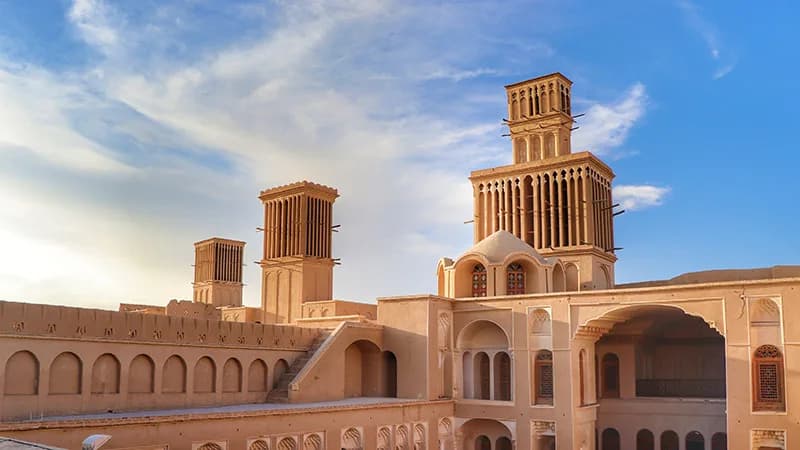
One of the most interesting elements of traditional architecture that developed in Iran’s hot and dry climate is the “badgir,” or windcatcher. These towers rising above buildings are a highly thoughtful system that helps with natural ventilation and cooling.
The hot and dry climate of Yazd led to the widespread use of windcatchers here. In the historic houses of Yazd, badgirs are usually used together with an inner courtyard, a pool, and thick walls.
Inside a badgir are vertical air channels. Wind enters through one of the open sides of the tower and is directed downward through the channel into the interior spaces of the building. At the same time, the air heated inside the building rises upward and exits through another channel or opening.
As a result, natural air circulation is created inside the building. No fan or other mechanical equipment is required here. The badgir uses the existing wind and differences in air temperature to create air movement inside the building.
The Role of the Pool
A badgir can also work without a pool. Its main function is to create air movement. Moving air removes heat from the surface of the human body more quickly, making the space feel cooler.
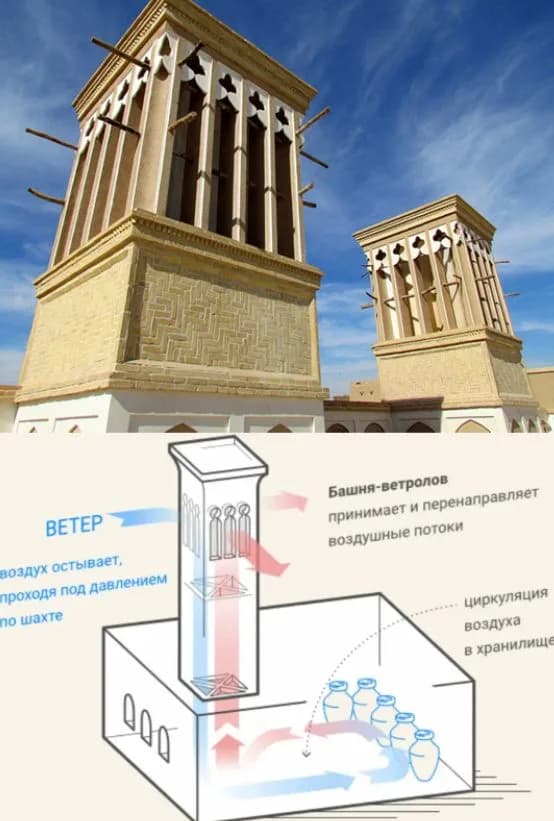
However, in traditional Iranian houses, the badgir is usually considered together with an inner courtyard and a pool. When the hot and dry air carried by the wind passes over the surface of the water, some of the water evaporates. Since the energy required for evaporation is taken from the air, the air cools down.
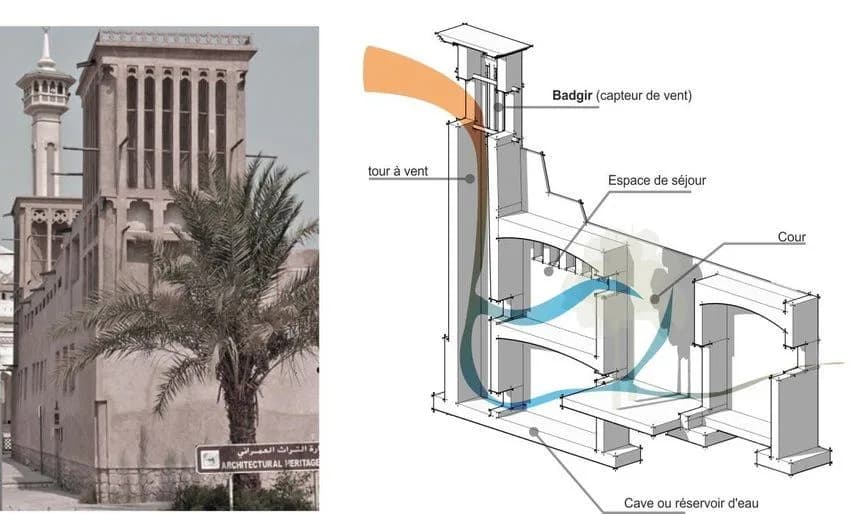
The cooled air then enters the living spaces. Therefore, using a badgir together with a pool can create more effective natural cooling in a dry climate.
Sand and Dust
Another problem in hot and dry climates is sand and dust. A badgir does not completely clean the air like an air filter in modern air conditioners. However, its structure can prevent some of the dust from reaching the living spaces.
This is related to changes in the direction and speed of the airflow inside the badgir. Large and relatively heavy particles of sand and dust moving with the wind cannot follow the same trajectory as the air, so they come into contact with the walls and lower parts of the channel, lose their speed, and settle.
During strong sand and dust storms, the openings of the badgir can be closed. This also helps prevent excessive amounts of dust and hot air from entering the building.
In traditional Iranian houses, coolness is not created by the badgir alone. The badgir, inner courtyard, pool, thick walls, and shaded spaces work together to create a natural cooling system adapted to the climate. Thick walls slow down the penetration of heat into the interior, shaded spaces protect against the sun, the pool cools the air through evaporation, and the badgir provides air circulation.
Centuries ago, people understood the characteristics of the environment in which they lived and adapted architecture to those conditions. They studied the land, climate, and wind and shaped their buildings accordingly.
Baku is also a city with a windy climate. Therefore, we need not only to preserve the urban structure formed in the past as historical heritage, but also to study the principles behind it.