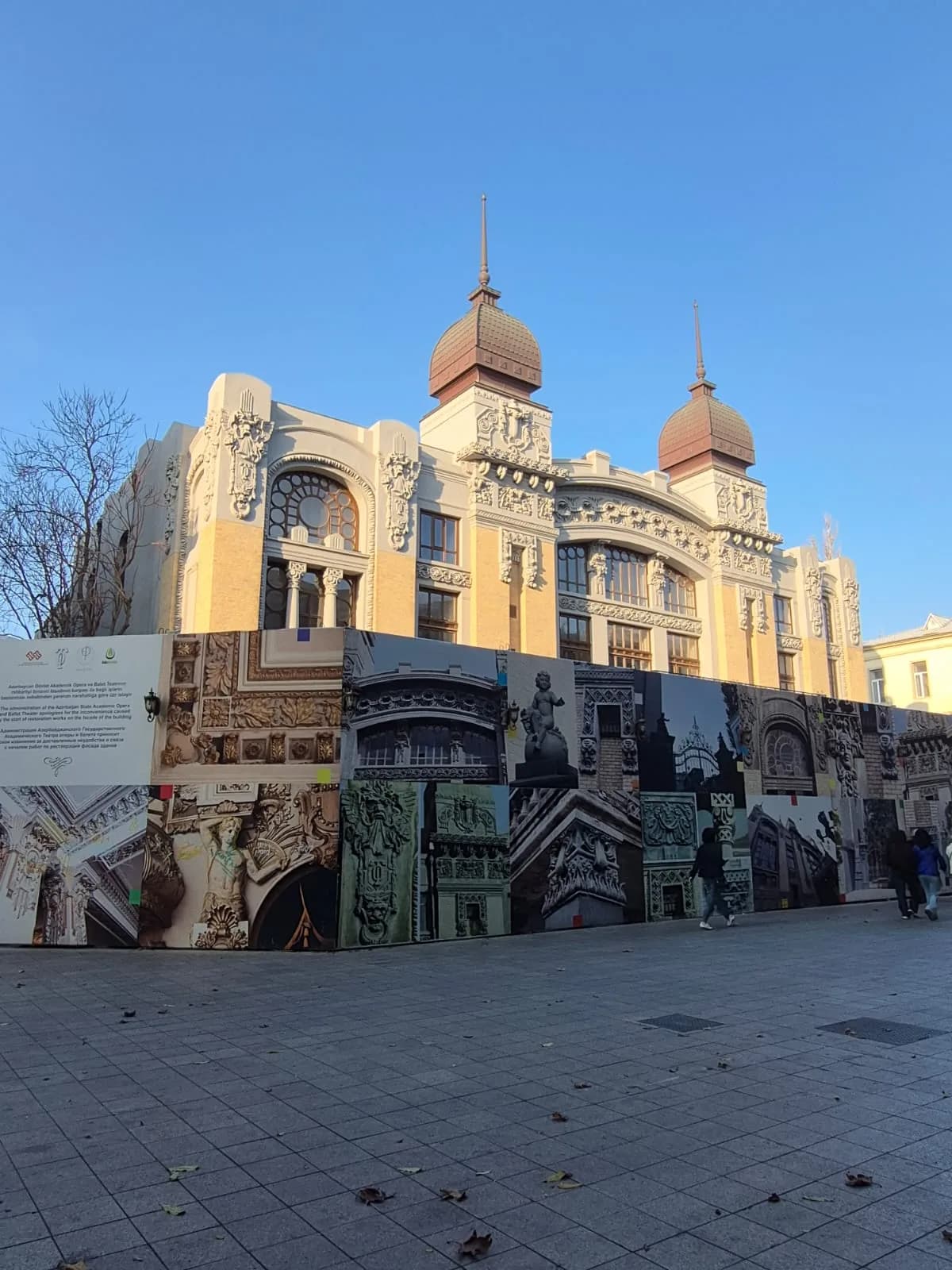
Opera and Ballet Theatre
One of my favourite buildings in Baku is the Opera and Ballet Theatre. One of the reasons I love this building is that, until four years ago, you could still feel the passage of time in its walls — a sense of age and history. Unfortunately, when we look at many of the city's historic monuments, we can hardly sense that they have witnessed the past unless we know when they were built.
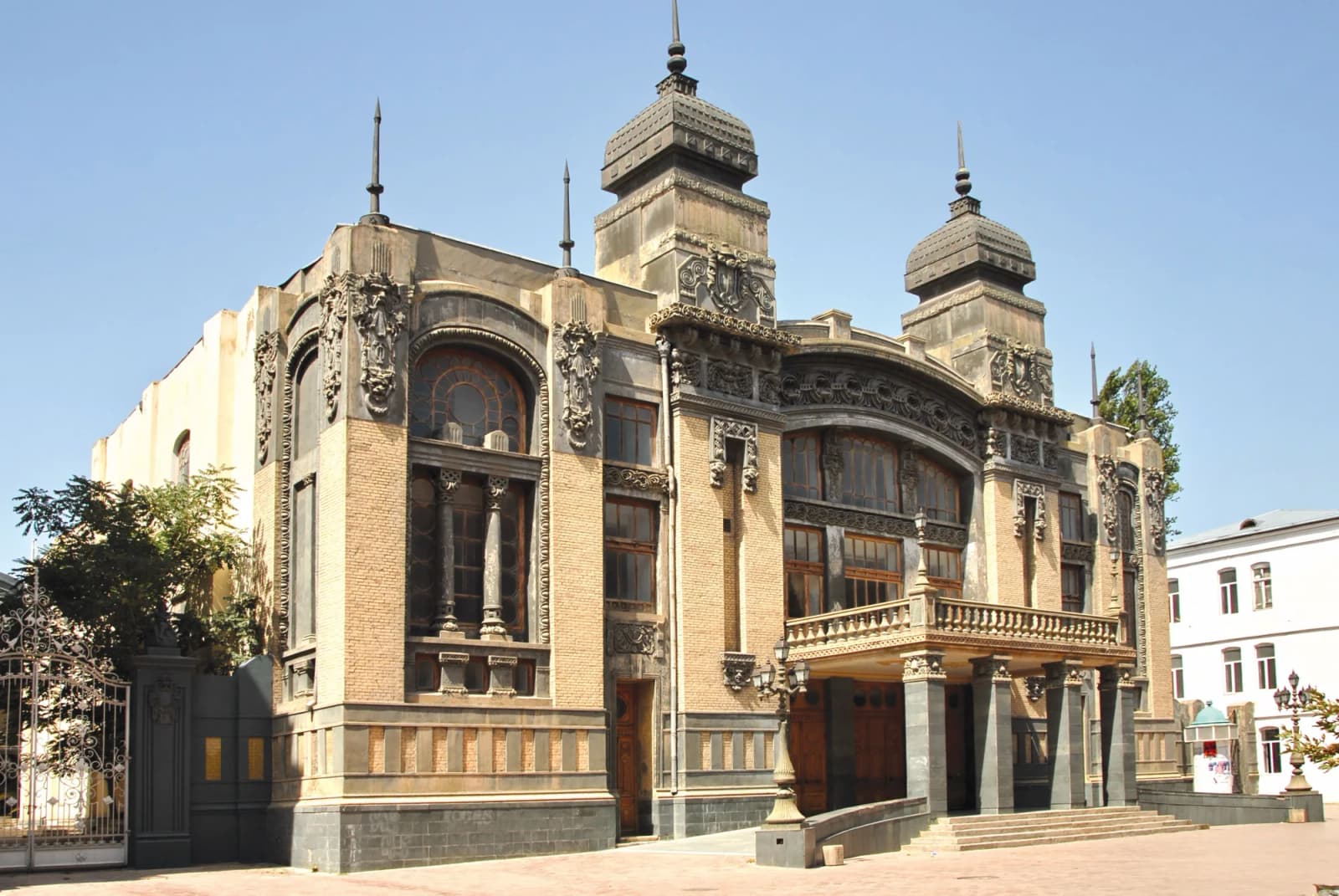
Over the past few decades, whitewashing buildings with lagonda (a type of lime-based coating) has become fashionable in Baku. Now, during restoration and conservation works, historic buildings are being painted and given a fresh look. They are not being restored; they are simply being renovated.
When looking at a building that is more than a century old, shouldn't we be able to feel its historical character and see the marks left by time? Why do we try to make our city look newer than it really is? After all, Baku is not Dubai...
History
The history of the Opera and Ballet Theatre is full of interesting facts and stories. In April 1910, the Mayilov brothers — Ilya, Ivan and Daniel — who were engaged in the fish trade, applied to the city administration for permission to construct a theatre on a plot of land they owned. However, permission was denied because the construction plans had not yet been fully prepared. Although the brothers received written notification of the decision, they continued construction without taking it into account. Upon learning of this, the city engineer arrived at the site and ordered the work to stop. Following this incident, architect and engineer Nikolay Bayev submitted a design for the theatre building.
Thanks to the rapid pace of construction, the building was completed in just ten months. Built in 1910–1911, this magnificent structure attracted attention not only for the speed with which it was erected but also for the legends that grew up around it.
One of the most famous stories associated with its construction claims that one of the Mayilov brothers commissioned the building for the sake of love...
According to the tale, the renowned Russian opera singer Antonina Nezhdanova visited Baku in 1910, at the beginning of the twentieth century, but could not find a suitable theatre in which to perform. During a reception held in honour of the singer, she was asked when she would return to Baku. The singer allegedly gave a firm, somewhat offended reply: never. The reason, she supposedly explained, was that “in such a beautiful and rapidly developing city, there is not a single opera stage.” She went on to say, “I am not accustomed to performing on the stage of a circus or a casino.”
The story goes that her remarks deeply offended Baku's millionaires, particularly one of the Mayilov brothers, who had supposedly fallen head over heels in love with her. He allegedly promised to build a theatre worthy of the singer's voice and appearance within a year.
Although we may enjoy romantic tales, the truth is different. For one thing, Antonina Nezhdanova never visited Baku. The first opera staged at the theatre was Modest Mussorgsky's Boris Godunov, with Alexander Mozzhukhin performing the leading role.
Another story concerns a supposed wager between Haji Zeynalabdin Taghiyev and one of the Mayilovs.
According to the legend, Mayilov set himself the goal of building the theatre within a year. Taghiyev, who had financed numerous buildings, including a theatre, found it hard to believe that such a magnificent structure could be completed in such a short time. A wager was therefore struck between them: if the theatre was completed within a year, Taghiyev would cover the construction costs; if it took longer, Mayilov would finish the theatre and present it to Taghiyev as a gift.
In the end, the building was completed in just ten months. However, there is reportedly no archival document demonstrating that Taghiyev paid for the construction. It is therefore more appropriate to regard this story not as an established historical fact but as one of the legends from Baku's past that has survived to this day.
The Mayilov brothers had correctly gauged the mood of Baku, a city experiencing an oil boom and rapid urbanisation. The number of wealthy residents was growing, while businesspeople and representatives of various professions were arriving from Europe. In such an environment, building an opera theatre represented an investment with the potential to generate considerable income. The fact that the Mayilov brothers completed construction in just ten months was likely connected to their desire to begin earning a return on their investment as quickly as possible.
Restoration and Reconstruction
The building first underwent reconstruction in 1938. We do not know what stories unfolded during those years, but the second restoration and reconstruction brought a number of remarkable events.
Between 1982 and 1984, the building was closed for restoration. A substantial amount of money was allocated, and considerable effort went into the work. Special tests were even conducted to assess the building's acoustics. During one such test, Muslim Magomayev performed a classical piece on stage, demonstrating the theatre's magnificent acoustics.
Yet all that effort and expenditure were wiped out in the blink of an eye. Just a short time before the planned reopening, when the building had been fully restored, a fire broke out. All the architectural drawings and project plans went up in flames.
Further restoration work was carried out in 1987–1988.
Since 2022, the theatre building has once again been closed for restoration. It remains unclear when it will reopen. According to the initial announcements, the work that began in 2022 was expected to be completed by the end of that same year.
However, according to a statement made this year by the theatre's director, Yusif Eyvazov, foreign specialists are preparing a restoration project for the theatre. He stated that the project is expected to be completed in 2026, after which the actual restoration work is due to begin.
Is the purpose of the restoration to return this historic building to its original architectural appearance, or will it be modernised under the guise of restoration, amounting to little more than renovation? We will only be able to answer this question once the project has been completed.
Let us hope that the renovation work carried out on the façade will not be repeated inside the building, and that a structure built in ten months will not take ten years to restore.