


Among all the regions of Azerbaijan, Sheki is my favorite, and whenever I get the chance, I try to visit it. When I think of Sheki, one of the first things that comes to mind is the old man playing the flute in front of the Palace of the Sheki Khans.
To be honest, I don’t particularly like the sound of the flute in everyday life. It wouldn’t be a lie to say that when I hear it on television, I sometimes change the channel. But in Sheki, in front of the Palace of the Sheki Khans, on the grass, the sound of the flute feels completely different. It is as if it touches your soul.
But why?
During my master’s studies, Gulchohra Mammadova talked in one of the courses she taught about examples of our cultural heritage included in the UNESCO World Heritage List. When she mentioned during one of those classes that the art of ashugs was also recognized by UNESCO, an expression appeared on the faces of us students: “Ashug art? :/”
But none of us was brave enough to say it out loud. After all, we were sitting in front of a rather serious rector.
Gulchohra khanum noticed the expressions on our faces and continued:
“If you sit on the 16th floor and listen to ashug music on your large plasma television, of course you won’t like it. But if you sit at the foot of a mountain, next to a flock of sheep and lambs, and listen to ashug music, it will touch your soul.”
And today I understand that everything really has its own place. You need to eat food where it belongs, and you need to listen to music where it belongs in order to truly enjoy it.
Cities are for plazas, packaged food, and loud music… Sheki, on the other hand, is the name of a completely different world for me.
Sheki is an ancient city through which merchants and travelers passed, a place where different cultures came into contact with one another. Perhaps that is exactly why I have such a strong sympathy for this city. I generally like cultural environments and places where different cultures have influenced one another.
During one of my trips to Sheki, I was talking to a woman when she said:
“The people here are different from the people in our other regions. They are very cultured. Unlike in other regions, women here are more free. They walk around freely and enjoy themselves.”
She gave a very interesting answer:
“This city was located on the Silk Road. We were able to adopt the positive qualities of the different peoples who came and went.”
Such a simple, yet such a profound thought.
Tourist cities do not develop only by improving people’s material well-being. They also absorb the cultural characteristics brought by the people, merchants, travelers, and different nations that have come to and passed through the city over the centuries.
Caravanserais
Sheki has many interesting buildings. But one of my favorite places, and perhaps my very favorite, is the caravanserai.
Thick stone walls, large arched gates, a spacious courtyard…
Caravanserais are architectural structures that emerged from the needs of their time. In a way, they are similar to today’s motels. I don’t say “hotel” because caravanserais were designed to accommodate not only people, but also camels and other pack animals.
Today’s camel is a car.
It is known that several caravanserais once existed in Sheki. The most famous ones that have survived to this day are the Upper and Lower Caravanserais.
Upper Caravanserai
Built in the late 18th century, the Upper Caravanserai has a three-story structure. Numerous rooms arranged around a large courtyard, arched passages, and enclosed spaces were designed according to the building’s main function.
Safety, comfort, and functionality were the priorities here.
A merchant stored his goods in the basement, traded on the first floor, and lived on the second floor. In this way, trade and living were combined within the same building.
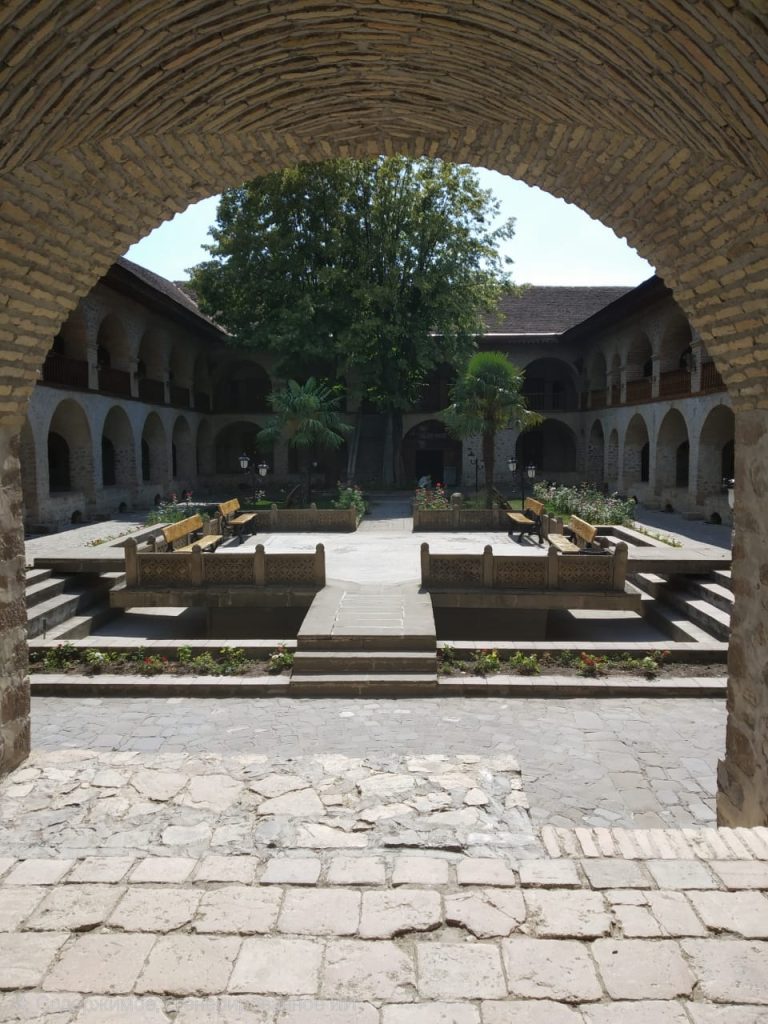
Inside the gates are brick vaulted domes. Due to the steep slope of the terrain, the richly decorated arch of the main entrance was built at the corner of the building, at the level of the third floor.
Today, when we enter this courtyard, we can no longer hear the sounds of caravans or the conversations of merchants arriving from distant countries. But the architecture still preserves traces of all of it.
One of the main qualities that makes historical buildings valuable is precisely this: when you enter them, it feels as though you are traveling through time. You can imagine who lived there and who passed through.
The caravanserai also made me think about another issue: how we treat buildings that have lost their original function.
When a building loses its original purpose, its fate does not necessarily have to be demolition. It is possible to adapt it to a new function and keep it alive.
The Upper Caravanserai is a beautiful example of this.
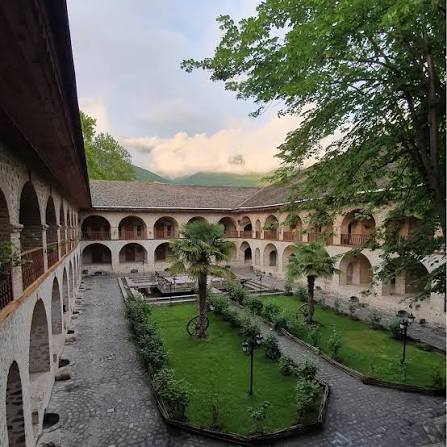
Today, it functions as a hotel complex. The vaulted structure of the spaces and the thick walls help maintain natural coolness during hot summer days. There is no need for modern air conditioning here because hundreds of years ago, people created architectural solutions adapted to the climate and the available materials.
Can’t we do the same today?
They even built bathhouses that could be heated with a single candle.
Now you tell me: have we really developed, or have we gone backwards?